
There’s a stat that should be uncomfortable for any executive running an AI strategy right now: 62% of organizations are experimenting with AI agents… but only 23% are scaling them. (Source) Over half of the enterprise world is running pilots, but less than one-quarter has actually moved into production at a meaningful scale.
While we’ve collectively gotten very good at experimentation, we’re not nearly as good at execution.
Why Pilots Don’t Translate to Production
The difference between working in a demo and working in real-life scenarios is where most AI value dies.
Gartner predicts that 30% of generative AI projects will be abandoned entirely after the proof-of-concept phase, and BCG found that 74% of companies have yet to generate tangible value from their AI investments. (Source, Source) Additionally, S&P Global Market Intelligence reported that the average organization scraps 46% of AI proofs-of-concept before they ever reach production. (Source)
Clearly, most pilots work fine in a controlled environment with clean data, a limited scope, and a dedicated team. The problem is that production is a completely different beast.
In production, you’re dealing with real data that’s messy, constantly changing, and siloed across legacy systems. You’re dealing with compliance requirements that the pilot team never had to think about. You’re dealing with actual users who behave unpredictably, and business processes that weren’t designed with AI in mind. The pilot program never had to survive any of that.
The organizations succeeding are the ones that design for production from day one, not as an afterthought once the demo lands well in the boardroom.
Fragmented Tools Create Fragmented Value
Another pattern that degrades AI ROI is enterprises treating every use case as its own separate project, with its own separate stack.
You end up with a customer service team running one agent framework, a finance team running another, and a legal team doing something else entirely. Each pilot gets its own tools, its own integrations, its own tribal knowledge. But nothing connects like it needs to in a live environment.
McKinsey notes that AI high performers are nearly three times more likely to have fundamentally redesigned workflows end-to-end, as opposed to AI onto existing processes piecemeal. (Source) This means the organizations capturing EBIT impact are the ones treating AI as infrastructure, not a series of one-off experiments.
The compounding advantage kicks in when your AI systems share a common orchestration layer, memory, and data access; every new deployment benefits from what came before. When they don’t, you’re starting from scratch every time. The fragmented approach may feel agile, but in practice, it just generates more pilots.
Agentic AI Has a Real Accountability Problem
As AI moves from answering questions to taking actions, like filing documents, executing workflows, and making decisions, the accountability question becomes urgent.
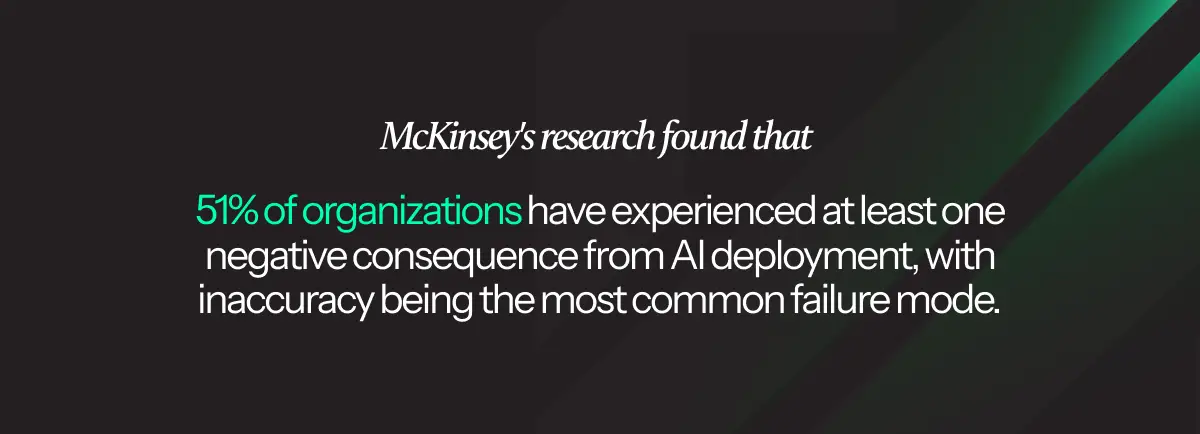
When AI agents can act, an inaccuracy becomes a wrong action that may already be downstream in a business process before anyone catches it.
Most organizations haven’t built a governance infrastructure, which is exactly why most agentic pilots die before they scale. The AI was ready to do the job, but the organization couldn’t safely let it.
From Pilot to Production: What Actually Changes the Equation
At Nevado, this is the exact problem we’re solving.
The path from pilot to production is as much an architectural challenge as a technical one. You need an orchestration layer that connects your AI agents, your data sources, and your enterprise systems in a way that’s consistent, auditable, and governed; a single operational backbone that scales with you as you move from one use case to ten.
That means built-in governance and compliance from the start, audit trails, role-based controls, as well as human-in-the-loop checkpoints where they matter.
Nevado helps enterprise teams move from AI experimentation to operational deployment, with the orchestration, governance, and compliance infrastructure to do it safely at scale. See how we can help you scale in days, not months.